Carpet Fitting Cost Bristol 2026 | What You'll Actually Pay
In Bristol in 2026, carpet fitting labour on its own runs roughly £4–£12 per square metre, or £150–£250 a day — with Bristol day rates measured at about £241, some 7% above the national average. But "fitting cost" means three different things depending on who is quoting, and the gap between them is where most of the confusion — and most of the unpleasant surprises — live.
Three different things are all called "the fitting cost"
This is the single reason price guides contradict each other, and it is worth two minutes before you read any further. When you ask what fitting costs, you may be quoted any one of these:
| What is being quoted | Typical 2026 figure | Who quotes it this way |
|---|---|---|
| Labour only — the fitter's time, nothing else | £4–£12 per m² | Independent fitters, trade directories |
| The fitting line on a retailer's invoice — labour, with grippers, underlay and door bars itemised separately | from £5.50 per m² | National retailers (Tapi's published rate card, July 2025) |
| The "fitted price" — carpet, underlay, grippers, labour, all in | £17–£114 per m² | Comparison sites (MyJobQuote, July 2026) |
A £6 per m² quote and a £60 per m² quote can describe exactly the same job. Before you compare two prices, establish which of the three you are looking at — and whether uplift, disposal, door bars and stairs sit inside or outside the number.
What the labour actually costs
Nationally, four independent sources agree on a fitter's day rate of £150–£250. For Bristol specifically, the trade-rate aggregator Hamuch puts the local figure at £241 a day, or about £31 an hour(live, August 2026), and HowMuchShouldItCost's 2026 modelling puts Bristol roughly 7% above the national average for this kind of work, with labour making up 59% of a typical job's cost and materials 41%.
Broken down smaller, MyJobQuote's July 2026 figures give £60–£80 per room and £75–£120 for a staircase and landing — labour only, in both cases.
Why stairs cost more per square metre than rooms
Every tread and riser is a separate cut, individually gripped and tucked. A winder tread — the pie-shaped ones on a turn — needs a bespoke template. A straight flight is roughly half a day's work; two to five hours is the usual range. Expect a premium of £10–£20 per m² over a flat room, and considerably more on winders.
| Staircase type | Labour only | Supply and fit |
|---|---|---|
| Straight flight | £100–£220 | £450–£1,400+ |
| With landing | £150–£320 | £550–£1,600+ |
| Winders / complex turns | £200–£450 | £650–£1,900+ |
Sources: FlooringCalculator (March 2026) for labour, BookaBuilderUK (2026) for supply and fit. These two are frequently quoted side by side as though they contradict each other. They do not — one is labour, one is the whole job.
The costs that are not the carpet and are not the labour
These are the items that turn a quote you were happy with into an invoice you were not. Tapi publishes an unusually transparent rate card, which makes it a useful reference point even if you buy elsewhere.
| Item | 2026 range | Note |
|---|---|---|
| Underlay, supplied and fitted | £8–£12 per m² | Budget PU foam through to premium crumb rubber. One outlier source quotes £16.99 — roughly double everyone else. |
| Gripper rods | £1.50–£3.00 per linear metre | £20–£60 for a typical staircase |
| Door bars / threshold strips | £8–£20 each | One retailer's published price is £12.99 |
| Uplift of old carpet | £1.50–£2.00 per m² | Or £30–£80 per room |
| Disposal of old carpet | from £4.00 per m² | See the Bristol section below — this one is local |
| Ply-lining a timber floor | £15–£25 per m² | Common in Bristol's older housing stock |
| Latex screed on concrete | £18–£50 per m² | More usual in newer builds and extensions |
A real itemised job
The trade supplier PlanIt Flooring published a full breakdown for a three-bedroom semi in July 2026, and it is worth reading twice:
| Line | Cost | Share |
|---|---|---|
| Carpet | £1,904 | 62% |
| Underlay, gripper, adhesive | £412 | 14% |
| Fitting labour | £525 | 17% |
| Uplift and disposal | £140 | 5% |
| Door bars and easings | £78 | 2% |
| Total, including VAT | £3,059 |
Labour is 17% of that job. The sundries, disposal and door bars together come to 21% — more than the fitting itself. If you are shopping on fitting price alone, you are negotiating over the smallest movable part of the bill.
What Bristol adds that national price guides miss
Every national guide treats the country as one market. Three things about working in Bristol change the arithmetic, and we have yet to find a competing price page that mentions any of them.
1. Bristol's tips will not take trade waste
Bristol Waste Company is explicit: a household waste recycling centre permit "does not allow you to bring business or trade waste." A fitter cannot simply take your old carpet to the tip on the way home. It goes to a licensed waste transfer station, under a registered waste carrier's licence, and it is weighed and charged.
That is why disposal appears as a line on the invoice rather than being absorbed. If a quote includes "free disposal", the cost has been moved somewhere else in the number, not removed from the world.
Larger clearances go in a skip, and in Bristol that carries its own paperwork. A six-yard skip runs roughly £195–£430 and an eight-yard skip £235–£540, with averages around £300 and £365. If it stands on the highway you also need a council skip permit at £90 per calendar month — applied for at least four working days in advance, with no extension mechanism, so a second month means a second £90 application. If a parking bay has to be suspended for it, that is a further £38 per day.
2. The Clean Air Zone
Bristol operates a Small Clean Air Zone (Class D), which charges cars and vans as well as larger vehicles. A non-compliant van pays £9 per day to enter. Vehicles meeting Euro 6 diesel — broadly registrations after 1 September 2015 — or Euro 4 petrol are compliant and are not charged. Note that "compliant" and "exempt" are different things: exemptions are a separate category you have to apply for, and most trade vehicles do not qualify for one.
Miss a payment and the penalty is £120, reduced to £60 if settled within fourteen days — and the council is clear that the discount applies to the penalty only. The £9 daily charge is still payable on top.
Whether it applies to your job depends on where you live and what the fitter drives. It is a fair question to ask, and a legitimate one for a tradesperson to price in.
3. Parking
Bristol City Council's trader parking permit costs £284 a year, or £92 for a book of twenty-five daily permits — about £3.68 a day, capped at three books per business year. In the controlled parking zones across central and inner Bristol, a fitter with a van full of carpet either holds one of these or feeds a meter.
Put together, a Bristol job can carry something in the region of £12–£13 a day in access costs alone before a single gripper rod is laid. That is not a reason to pay more than the work is worth. It is a reason to understand why a Bristol quote and a quote from a rural fitter thirty miles away are not describing the same job.
What the carpet itself costs — and why the guides are wrong
Almost every online price guide puts budget polypropylene at £5–£15 per m², and those figures are real — online-only retailers genuinely list polypropylene twists from around £4–£6 per m² today. It is worth understanding what that buys, because it is not the same product conversation you will have in a showroom.
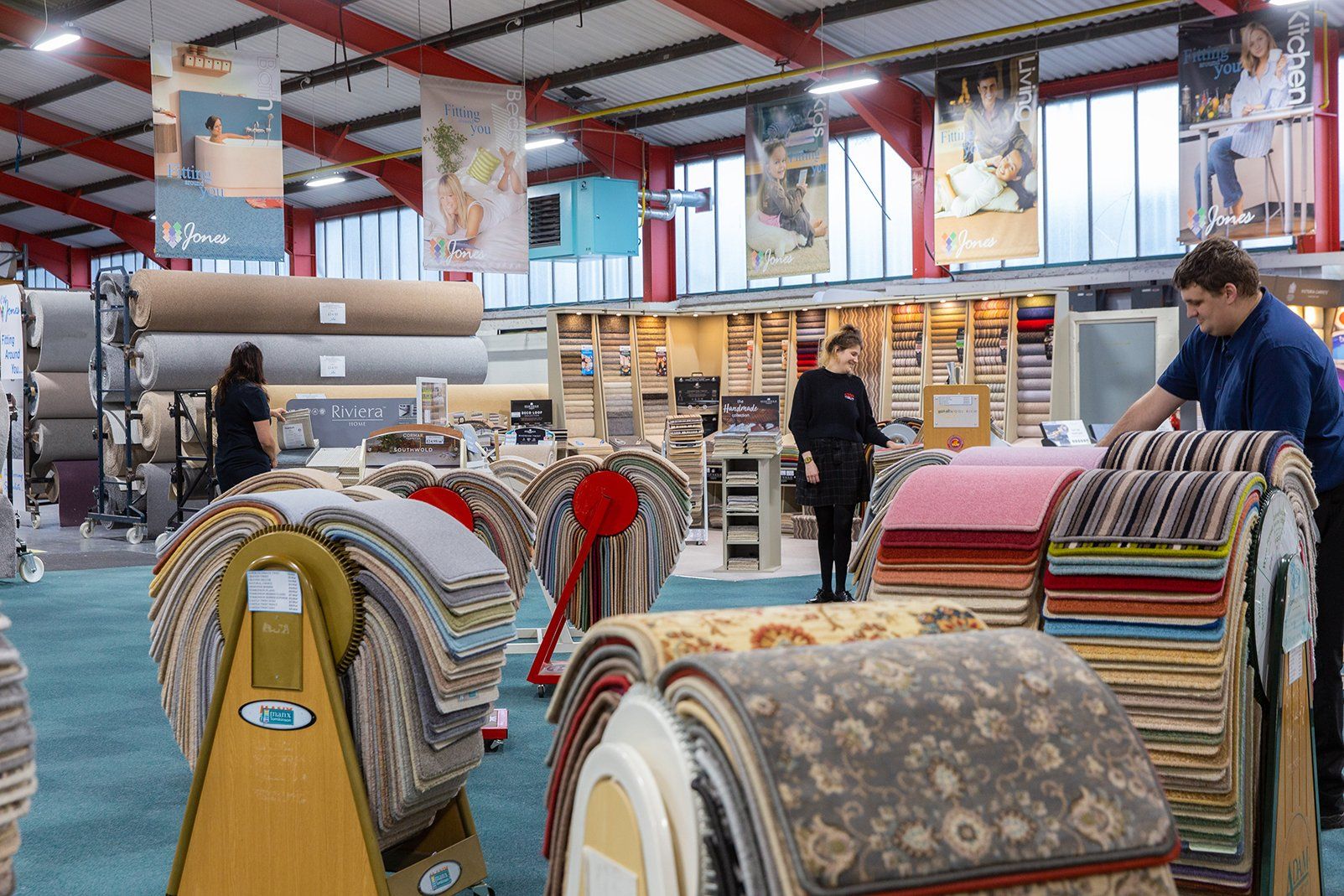
At the bottom of the market you are choosing from whatever is in stock, in the width it comes in, in a handful of colours, sight unseen. Move to a high-street retailer's own polypropylene range and the entry point is closer to £19–£23 per m². Move to a showroom with a full colour book, a choice of widths that suit your rooms, and a fitter who has seen your subfloor, and it is different again. None of these is a rip-off; they are different things.
Working figures for 2026, for carpet you would choose from a showroom:
| Carpet type | Material, per m² | Supplied and fitted, per m² |
|---|---|---|
| Polypropylene (budget to mid) | £23–£45 | £30–£55 |
| Wool-blend twist (80/20) | £30–£55 | £40–£70 |
| 100% wool loop / berber | £35–£65 | £45–£80 |
| Wilton | — | £54–£104 |
| Axminster | — | £64–£114 |
Supplied-and-fitted figures for Wilton and Axminster from MyJobQuote, July 2026. Material prices cross-checked against live retailer listings, August 2026.
Whole-house and whole-room figures
| Job | Supplied and fitted |
|---|---|
| Small bedroom, around 10 m² | £300–£550 |
| Living room, around 20 m² | £600–£1,100 |
| Stairs and landing, around 10 m² | £360–£900 |
| Hallway, around 6 m² | £220–£400 |
| Three-bedroom house throughout, around 70 m² | £2,000–£5,500 |
That last range is genuinely wide, and any guide that gives you a single number for it is guessing. The spread is driven by four things: the carpet you choose, whether stairs are included, whether uplift and disposal are in the quote, and whether the subfloor needs work. Published averages for a three-bed run from about £2,520 to £4,708, rising to £5,588 once disposal is added — which tells you how much of the variation is in those last two items.
VAT: the bit that catches new-build buyers
Carpet fitting is standard-rated at 20%, and there is no reduced rate for domestic work.
The exception people expect — and do not get — is on a new build. HMRC's construction manual is unambiguous: "carpets and carpeting material, such as carpet tiles, are excluded from the meaning of 'building materials'", while "all other fixed floor coverings (such as vinyl and parquet) are 'building materials'" (VCONST13800). Because carpet is not a building material, its installation cannot be zero-rated either.
So on a zero-rated new build, parquet, hardwood and ceramic tiling can be zero-rated while the carpet and its fitting stay at 20%. Gripper rods and stair nosings sit outside the restriction — but only, in HMRC's words, "as long as they are separately identifiable from the carpet supplied". Bundled into a single supply-and-fit price for the carpet, that relief disappears. If you are buying for a new build, ask for them itemised.
This is a summary, not tax advice. If a new build or a conversion is involved, the rules differ again between the two and it is worth checking with your accountant — the reduced-rate conversion regime in VAT Notice 708 section 7 works on a different basis from the new-build rules.
One practical consequence: a sole trader under the £90,000 VAT registration threshold can quote roughly 20% below a registered business for reasons that have nothing to do with the quality of the work. Worth knowing when you are comparing.
Underfloor heating: check the tog before you choose
If you have underfloor heating, the carpet and underlay together must not exceed 2.5 tog, and manufacturers recommend staying preferably under 1.5 tog if the system runs from a heat pump. The underlay alone should be at or below 0.8 tog. There are specialist products designed for it: Duralay's Heatflow Carpet underlay, for instance, is 0.75 tog at 6.10 mm.
Here is the awkward part. Underlay manufacturers publish tog values; carpet manufacturers almost never do. You cannot do the sum yourself from the labels. A 12 mm luxury foam underlay paired with a wool twist will breach 2.5 tog on its own — and you will not find that out from the swatch. This is a question to ask before you buy, not after.
Seven questions worth asking before you accept a quote
- Is this labour only, or supplied and fitted?
- Does it include underlay, grippers and door bars — and how many door bars?
- Is uplift of the old carpet included? Is disposal?
- Has the subfloor been assessed, and is any ply-lining or screeding in this price?
- Are stairs priced separately, and does the figure account for winders?
- Is VAT included in the figure I am looking at?
- If I have underfloor heating, what is the combined tog of this carpet and this underlay?
Frequently asked questions
How much does it cost to fit carpet per square metre in Bristol?
Labour alone is typically £4–£12 per square metre in 2026, with Bristol rates around 7% above the national average. A full supplied-and-fitted price, including carpet, underlay and grippers, more commonly falls between £30 and £80 per square metre depending on the carpet.
How much do carpet fitters charge per day?
£150–£250 a day nationally. Bristol trade rates have been measured at around £241 a day, or £31 an hour, in 2026.
How much does it cost to carpet stairs and a landing?
Labour alone is around £75–£220 for a straight flight, £150–£320 with a landing, and £200–£450 for winders. Supplied and fitted, a straight staircase typically lands between £450 and £1,400 depending on the carpet.
Is underlay included in a carpet fitting quote?
Usually not. It is generally itemised separately at £8–£12 per square metre supplied and fitted. Always confirm — it is one of the two most common reasons a final invoice exceeds the quote.
Who disposes of the old carpet?
Your fitter, but it is chargeable — typically £1.50–£2.00 per square metre to lift and from £4.00 per square metre to dispose of. In Bristol this is not optional cost-padding: household waste centres do not accept trade waste, so old carpet has to go to a licensed transfer station and is weighed and charged.
Does carpet fitting attract VAT on a new build?
Yes. Carpet is excluded from HMRC's definition of building materials, so both the carpet and its installation are standard-rated at 20% even on a zero-rated new build — unlike hardwood or ceramic tiling.
Why are online price guides so much cheaper than showroom prices?
Because they are usually quoting online-only stock lines — polypropylene from around £4–£6 per square metre is genuinely available, but in whatever colour and width happens to be in stock. A high-street retailer's own polypropylene range starts closer to £19–£23, and a showroom range with a full colour book and a width chosen to suit your rooms is different again. The guides are not wrong; they are describing a different purchase.
Can I have carpet fitted over underfloor heating?
Yes, provided the carpet and underlay together stay under 2.5 tog — under 1.5 if the heating runs from a heat pump. Carpet manufacturers rarely publish tog values, so this needs checking with your retailer rather than reading off the label.
How long does carpet fitting take?
A single room is usually a couple of hours. A straight staircase is around half a day. A three-bedroom house throughout is generally a full day, sometimes two if the subfloor needs preparation.
What should I do before the fitter arrives?
Clear the room completely, including wardrobes if they are being moved. Take doors off if they will need trimming. If the old carpet is being lifted by the fitter, leave it down — pulling it up yourself rarely saves anything and can damage the grippers underneath.
Getting a Bristol quote
Every figure on this page is a published UK or Bristol benchmark, current as of August 2026. They will tell you whether a quote is in the right territory. They will not tell you what your job costs, because that depends on your rooms, your stairs, your subfloor and the carpet you fall for.
We measure and quote free across Bristol, Bath and South Gloucestershire, and the quote itemises every line on this page so you can see exactly what you are paying for. You are welcome to visit the showroom on Vale Lane in Bedminster and walk the ranges first — free parking, no appointment needed. Or book a free measure and quote and we will come to you.
See also: carpet ranges in our Bristol showroom · bound stair runners · current offers